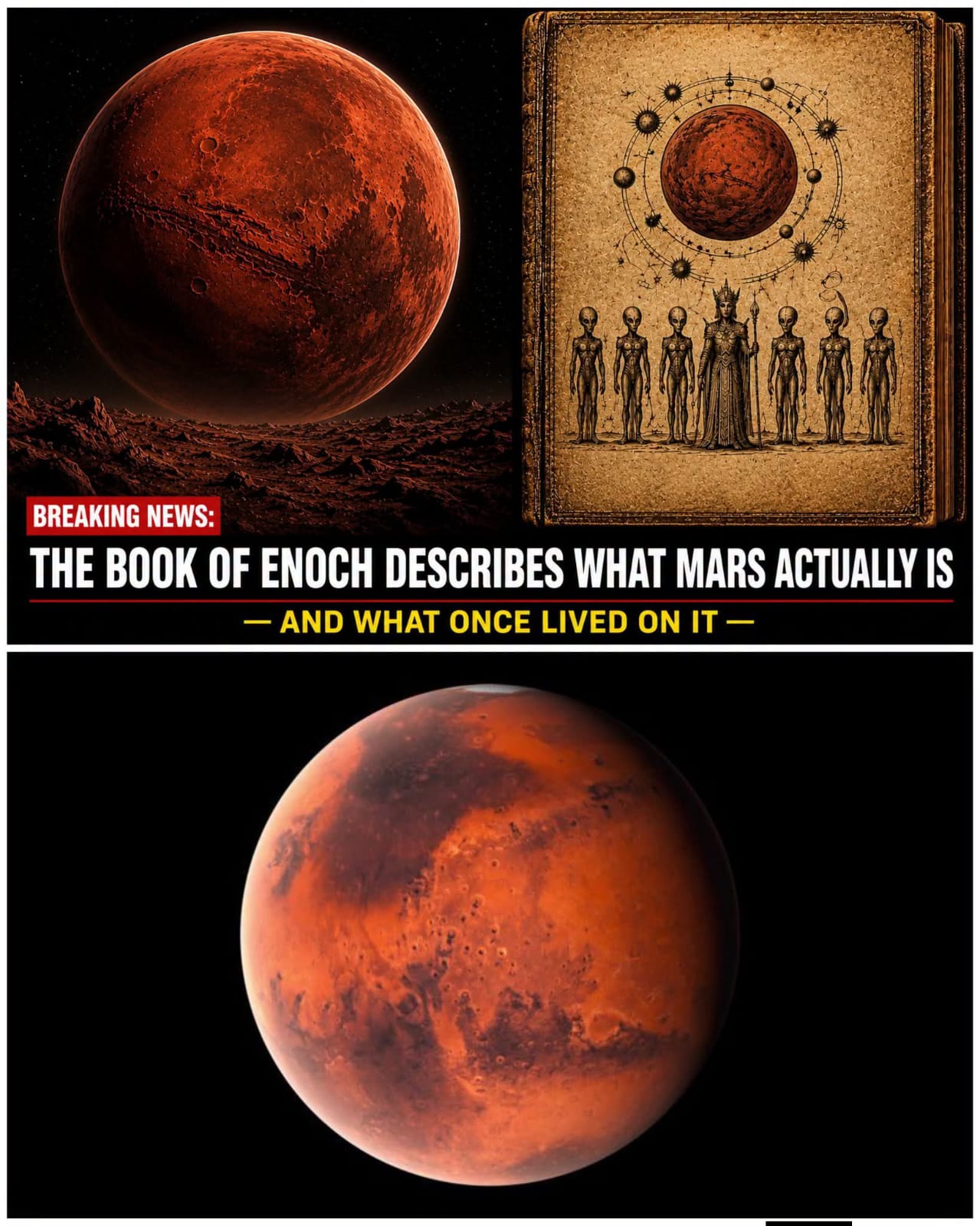
The Book of Enoch Describes What Mars Actually Is — And What Once Lived on It
What if Mars was not always the cold, barren world we see today?
For centuries, the Red Planet has fascinated humanity. Modern science has revealed that Mars once had rivers, lakes, a thicker atmosphere, and conditions that may have been suitable for life.
But an ancient text adds a much stranger dimension to the mystery.
The Book of Enoch describes a universe filled with celestial beings, heavenly realms, appointed positions, rebellion, and divine judgment. It never directly says that Mars was once inhabited, yet its descriptions have inspired modern theories about whether ancient stories could preserve symbolic memories of events involving worlds beyond Earth.
Could Mars have once been dramatically different?
And could the strange visions recorded thousands of years ago somehow echo the story of a lost world?
The Ancient Mystery Behind Mars
The Book of Enoch presents the heavens as an organized creation. Stars follow their appointed paths, celestial beings have specific roles, and those who violate the established order face punishment.
One of the most mysterious elements of the text is its description of beings who abandon their assigned positions and rebel against the order of heaven.
The ancient text does not identify these beings as Martians, nor does it say that they destroyed Mars.
That connection comes from modern interpretation.
Yet the comparison becomes fascinating when we look at what science has discovered about Mars.
Today, Mars is a freezing desert covered by dust, rocks, enormous valleys, and ancient geological scars.
But billions of years ago, its environment appears to have been very different.
Evidence gathered by spacecraft and Mars rovers shows that liquid water once existed on the planet’s surface. Ancient rivers carved channels through the landscape, while lakes occupied large basins.
For a period of Martian history, the planet may even have possessed conditions capable of supporting microbial life.
That alone makes Mars one of the greatest mysteries in our solar system.
What Happened to Mars?
Mars did not suddenly transform from a habitable world into the barren planet we see today.
Its decline appears to have occurred over an enormous period of time.
The planet gradually lost much of its atmosphere. As the atmosphere became thinner, the surface became colder and increasingly hostile to liquid water.
One of the most important clues is Mars’ ancient magnetic field.
Scientists believe that Mars once had a stronger global magnetic field generated by an internal dynamo. This magnetic protection helped shield the atmosphere from the effects of the solar wind.
Eventually, that internal dynamo shut down.
Without the same level of magnetic protection, Mars became increasingly vulnerable to atmospheric loss. Over immense stretches of time, its atmosphere became thinner, surface water became unstable, and the planet evolved into the cold and dry world we know today.
There is no scientific evidence that a celestial war caused this transformation.
There is also no confirmed evidence that the mysterious Watchers described in the Book of Enoch ever governed Mars.
But the contrast between the ancient story and the scientific history of Mars is undeniably intriguing.
Could Ancient Stories Describe a Cosmic Catastrophe?
The Book of Enoch describes celestial beings, cosmic order, rebellion, and judgment.
Science describes a planet that underwent a profound environmental transformation.
These are two completely different explanations.
One belongs to ancient religious tradition. The other is based on geological and planetary evidence.
But what if ancient people sometimes expressed extraordinary ideas through symbolic stories?
Could descriptions of celestial rebellion and destruction have represented humanity’s attempt to understand mysterious events in the heavens?
There is no evidence proving such a connection.
Still, the question remains fascinating.
Mars was once warmer and wetter.
Today, it is cold, dry, and seemingly lifeless.
Something happened to transform that world.
What Could Have Lived on Mars?
The strongest scientific evidence suggests that ancient Mars was significantly wetter and potentially more habitable than it is today.
That does not mean that an advanced civilization once lived there.
Scientists have found no confirmed evidence of an ancient intelligent Martian civilization.
But the possibility of ancient microbial life remains one of the most exciting questions in planetary science.
If life ever existed on Mars, it may have been microscopic.
And if it survived long enough in the planet’s ancient environment, traces of that life could potentially remain preserved in rocks beneath the surface.
This is where the mystery becomes even more compelling.
The Book of Enoch gives us an ancient vision of celestial order, supernatural beings, rebellion, and judgment.
Mars gives us the physical remains of a world that experienced enormous environmental change.
Neither one proves the other.
But together, they raise an extraordinary question:
Was ancient humanity simply imagining mysterious worlds beyond Earth, or were these stories inspired by observations and ideas that have been lost to history?
The Mystery Is Still Open
Perhaps the most important lesson is not that the Book of Enoch secretly described Mars.
It didn’t explicitly do so.
Instead, the ancient text reveals something fascinating about humanity itself: people thousands of years ago were already looking toward the heavens and trying to understand the forces that governed the cosmos.
And Mars may have been a very different world during that distant past.
Water once flowed across its surface.
Its atmosphere was thicker.
Its environment may have been capable of supporting microbial life.
Today, the Red Planet appears silent.
But beneath its dust and ancient rocks could still lie evidence of what happened when its world changed forever.
Future missions may uncover more clues about Mars’ lost environment—and perhaps even evidence of ancient life.
The greatest discovery may still be waiting beneath the surface.
Because Mars may not simply be a dead world.
It may be the remains of a world with a story we have only begun to understand.
Leave a Reply